On Saturday, March 1, I attended a seminar hosted by the Croix Valley Tracking Club. Dr. Dodds filled a whole day with fascinating information about canine health issues. Since she is most well known for her research in the area of thyroid dysfunction, that's where I'll start.
Basics
Basal thyroid levels are different for puppies (higher), middle aged dogs, and geriatrics (lower). More importantly, basal thyroid levels are also dependent on breed and even different lines within a breed (her example was the difference in basal thyroid levels for African bred Basenjis and North American bred Basenjis). Sighthounds have their own category, and their basal thyroid level is lower. For this reason, it is important to assess thyroid function with the signalment (age, breed, sex) of each dog in mind. She is obviously a proponent of sending all thryoid samples to her for analysis and diagnostics at her facility: Hemopet.
Why is her report different?
First, the analysis is more comprehensive. The Thyroid Profile 5 includes T4, freeT4, T3, freeT3, and TgAA. (Many veterinarians are still recommending just a T4 for screening purposes, which provides incomplete data for accurate diagnosis.) She is an OFA certified laboratory as well as offering her own Thyroid Gold registration and certificate for dogs deemed normal within their respective breed's levels.
Second, the results are interpreted by Dr. Dodds personally and a consultation with follow up is included in the price.
Third, each dog's result is evaluated based on the data collected for other dogs of the same breed. Dr. Dodds confidently says this is the most accurate way of correctly diagnosing (and treating) hypothyroidism in dogs. She does offer the option of interpreting thyroid results from an outside lab, as that is more convenient for some people. However, she did mention during a break that there are also differences in medical testing equipment and reference ranges for humans and animals. Therefore, she will recommend sending the sample to certain labs over others.
Why test?
Symptomatic dogs are generally the only dogs tested. The problem is that there are "normal" symptoms that most vets, and even the general public will notice. And then there are the not-so normal symptoms. Typical clinical signs include: moodiness, erratic temperament, disorientation, hypoattentiveness, depression, anxiety, unprovoked aggression, sudden onset seizure disorder, and compulsiveness. More subtle changes include a change in muscle in the face which leads to a change in the dog's expression; there can be significant temporal muscle wasting above and below the eyes. Seborrhea oleosa (oily skin) and seborrhea sicca (dry skin) can both be indicators of hypothyroidism. Inability to regulate body temperature is also a symptom of hypothyroidism that can go unnoticed for months due to weather changes, among other reasons.
Breeding is the number one reason a dog should be tested for hypothyroidism. Autoimmune thyroiditis is a heritable trait and will be present in the dog, even if not showing clinical signs. If a dog has autoimmune thyroiditis (genotype), that doesn't automatically mean the dog is currently hypothyroid (phenotype). Testing for heritable autoimmune thyroiditis requires T3AA, T4AA, and TgAA. Dr. Dodds recommends that potential breeding dogs be screened for the first time just after puberty. In bitches that is 12-16 weeks from the onset of estrus, and in males 10-14 months. Ideally, the dog would have two negative tests by age 3 before considering breeding. It is important to continue to screen regularly (recommended yearly for breeding dogs, less frequently for non-breeding dogs).
Other causes
Basal thyroid level can be suppressed up to 25% by certain medications such as steroids, phenobarbital, sulfonamides (overlooked sulfas: Zonisamide & Deramaxx), and excess iodine. Iodine (found in kelp, a commonly used dietary supplement for dogs) excess and deficiency can cause immune responses. Iodine depletion is one cause of dietary induced hypothyroidism. While Dr. Dodds is a proponent of raw feeding, she did caution feeding throat/gullet meat because it has been linked to dietary hypothyroidism in dogs and hyperthyroidism in cats. Her advice was to know where the meat is coming from, specifically. Rabies vaccines given within 45 days will cause an elevated TgAA. Neck pressure from all types of collars has also been linked to thyroid disorders. An article by Peter Dobias, DVM was referenced as an anecdotal example of neck injuries leading to hypothyroidism.
Treatment
Dogs and cats should receive thyroid treatment twice daily. In an ideal world the medication would be given one hour before ingestion of calcium or soy and exactly twelve hours apart. Realistically, it is more important to give the medication one hour before or three hours after meal time. The animal should either be pilled dry, or you can use a food without calcium or soy such as peanut butter. Read the label carefully on anything that is designed to "hide" the medication, to make sure calcium and soy aren't ingredients. Brand name (Soloxine, ThyroTabs) thyroid treatment has proven to provide more reliable results than generic. Depending on the type of thyroid disorder, natural thyroid supplementation can be considered. These are typically bovine or porcine based (Nature Throid, Westhroid Pure Thyroid, ERFA-Canada only). Supplementation should not be started before consulting with a veterinarian.

2014-03-03

2014-02-05
Trial Preparations
If I'm actually going to show Gabby (and Siri!) at the MMBC WCRL trial in April, I figured I should probably train the dogs!
My focus with Gabby has been heel position and stays. Yesterday we had three training sessions, one of which was in public. Gabby has a staring problem. I generally attribute it to her lack of vision as that seems the most likely reason a normal/stable dog would stare at other dogs for an uncomfortable length of time without reacting.
Yesterday our field trip was to the dog park. This dog park is really nice because I can walk about 10 feet outside of the fence line, and we can work on reorienting. The first pass, I think she stared at a dog for a full minute before reorienting. And then the dog would move and she'd stare again. We slowly made our way down the fence-line then took a detour to play/train away from the other distractions. When we made our way back to the car, Gabby was offering bouncy behavior, attention, and reorienting at an alarmingly fast rate.
This scenario isn't new to Gabby but the situation was. We usually either go into the dog park (when it's empty) or we walk the trails. I was very happy to see that the work I've been putting in has been paying off!
Our other training sessions yesterday involved pedestal work, right finishes, and stays. Today we worked on transitioning between food and toys. I still can't quite believe that we're finally to the point where she will re-engage with a toy after I've used food. That was an incredibly lengthy process, but she was doing it pretty well this morning!
Goals for the rest of the week: downs, stays, stand, and more toy/treat work!
My focus with Gabby has been heel position and stays. Yesterday we had three training sessions, one of which was in public. Gabby has a staring problem. I generally attribute it to her lack of vision as that seems the most likely reason a normal/stable dog would stare at other dogs for an uncomfortable length of time without reacting.
Yesterday our field trip was to the dog park. This dog park is really nice because I can walk about 10 feet outside of the fence line, and we can work on reorienting. The first pass, I think she stared at a dog for a full minute before reorienting. And then the dog would move and she'd stare again. We slowly made our way down the fence-line then took a detour to play/train away from the other distractions. When we made our way back to the car, Gabby was offering bouncy behavior, attention, and reorienting at an alarmingly fast rate.
This scenario isn't new to Gabby but the situation was. We usually either go into the dog park (when it's empty) or we walk the trails. I was very happy to see that the work I've been putting in has been paying off!
Our other training sessions yesterday involved pedestal work, right finishes, and stays. Today we worked on transitioning between food and toys. I still can't quite believe that we're finally to the point where she will re-engage with a toy after I've used food. That was an incredibly lengthy process, but she was doing it pretty well this morning!
Goals for the rest of the week: downs, stays, stand, and more toy/treat work!
2014-01-20
Geriatric Care: Enrichment
Geriatric care is a topic that has become very near and dear to my heart. Having a geriatric animal (or four) is emotionally taxing, and expensive. Despite that, I want to be able to say I did everything I could to make sure those last years, months, days, and hours were well lived.

This topic will be broken up into four blog posts.
1. Enrichment
2. Exercise
3. Nutrition
4. Pain Management
Enrichment
Merriam-Webster says the definition of enrich is "to improve the quality of (something)." When discussing enrichment specifically for geriatric animals, it is important to keep the brain active, especially when the body starts to slow down. The Shape of Enrichment, Inc has created five categories for enrichment. The five categories are not mutually exclusive. The categories are social, cognitive, physical habitat, sensory, and food. I likely won't address all of these, but being cognizant of all five is important.
Sniffing-walks which I try to do daily, even if it is only for 5-10 minutes. Buzz loves to get out and check the pee mail, see if any new animals have visited, and it's good for both of us to breathe in some fresh air! I usually take him out alone.
Food toys use to be a huge part of Buzz's life. He LOVED to play with his Tug A Jug and especially chew on Kongs. Now that his mobility is limited (and he took a few too many headers into the floor after losing his balance following a toy on the floor) I had to find a different toy to stuff. The JW Megalast Bone has been a great alternative! I stuff it with canned food and freeze it. It can't roll away from him, he still gets to chew, and I can still control his diet.
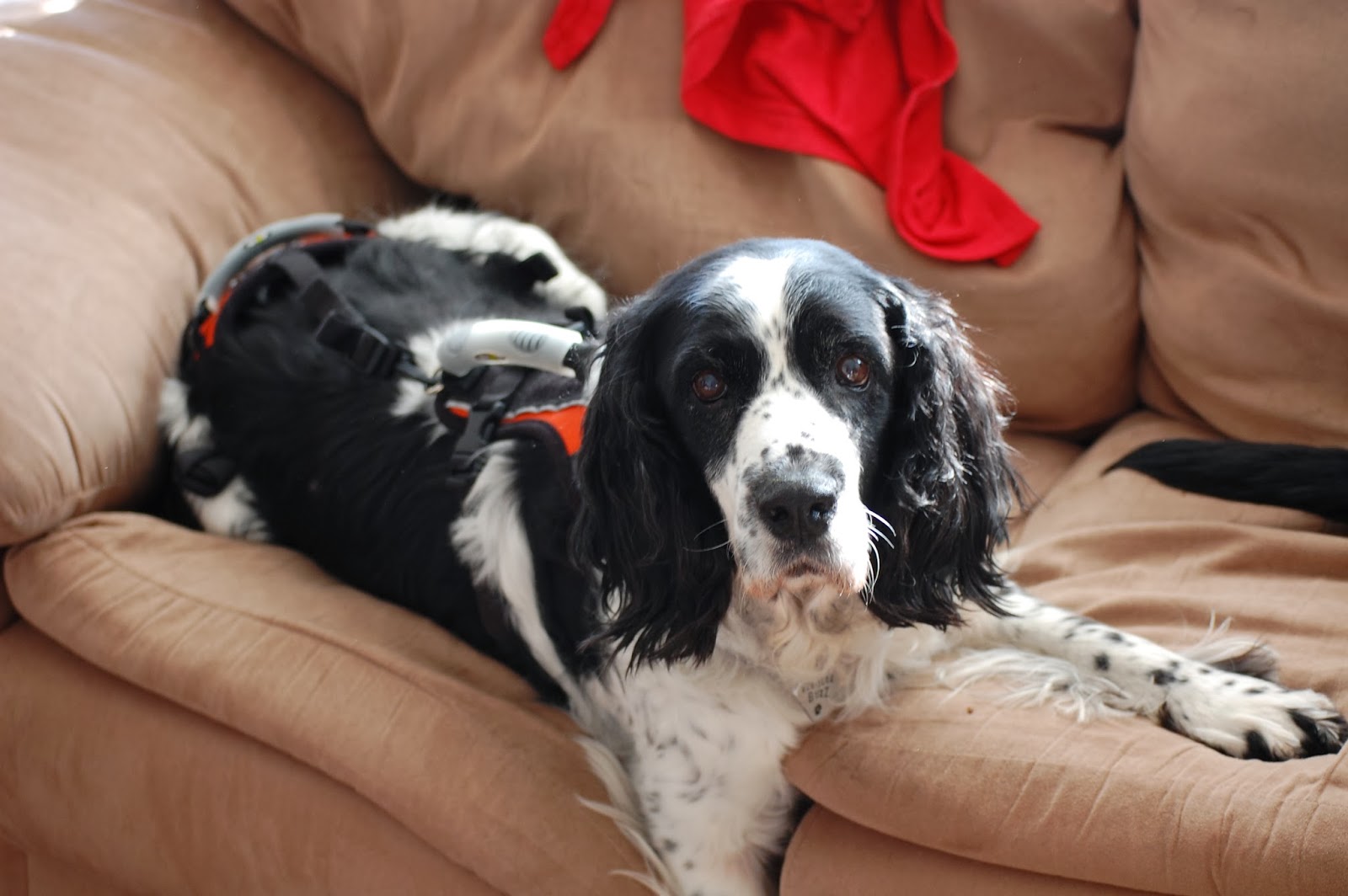
Store visits are an option again now that Buzz is strong enough to walk on linoleum! We used to go to stores so he could look at the fish. He LOVED looking at the fish. Now we go so he can look at the small animals and check out the treat/chew aisle. Last time I took him to a store, we were in there for about half an hour. He had SO much fun! When we got home, he just crashed out--mission accomplished. That was a mental and physical stimulation visit! Social enrichment is typically part of store visits. I don't make people pet him, but I do encourage it now rather than discourage it. He had a very nice lady love on him for at least five minutes last time we were out. She pet his ears and told him what a good boy he was. It was really neat to see someone appreciate him like that.
Play isn't something Buzz has ever done much of. Occasionally he will show interest in a toy of Gabby's and when he does, I take advantage of that. He's much more likely to play with a toy if Gabby has already been playing with it. Just this morning I had a toy out with a gazillion squeakers. When he saw how much fun Gabby and I were having, he just had to join in! So we played the game where I put it on his head and then release him. He throws his head back and tries to catch the toy. Other variations of play are retrieves and holds. He will do those with enthusiasm for food!

Training is one of our favorites, now that I've thought of ways to modify most of the behaviors he knows. We'll often sit on the floor and do nose target/foot target discrimination games (where I feed him for every single correct response, because why not). A week or two ago he wanted to work on the pedestal while I had Gabby out. Standing on it was hard, so he elected to sit on it instead. It was so hilarious! We work on stand to down (because sit to stand is hard) and when he's in the underwater treadmill at work, he loves to practice his spins in both directions.
Resting places are changed as frequently as I remember. I move his bed around to different locations in the apartment and I rearrange the blankets on it almost daily. As much as that doesn't sound like a big deal, it's an indicator of his cognitive state that he can find the new location of his bed. Oh, and he prefers to be near people while he's resting so he spends a fair amount of time resting on some part of me when I'm home. Yesterday, he fell asleep on my feet as his bed is currently in front of the couch. He can't seek out other animals to cuddle with but is so happy when Gabby or Rasza choose to curl up next to him.
This topic will be broken up into four blog posts.
1. Enrichment
2. Exercise
3. Nutrition
4. Pain Management
Enrichment
Merriam-Webster says the definition of enrich is "to improve the quality of (something)." When discussing enrichment specifically for geriatric animals, it is important to keep the brain active, especially when the body starts to slow down. The Shape of Enrichment, Inc has created five categories for enrichment. The five categories are not mutually exclusive. The categories are social, cognitive, physical habitat, sensory, and food. I likely won't address all of these, but being cognizant of all five is important.
Sniffing-walks which I try to do daily, even if it is only for 5-10 minutes. Buzz loves to get out and check the pee mail, see if any new animals have visited, and it's good for both of us to breathe in some fresh air! I usually take him out alone.
Food toys use to be a huge part of Buzz's life. He LOVED to play with his Tug A Jug and especially chew on Kongs. Now that his mobility is limited (and he took a few too many headers into the floor after losing his balance following a toy on the floor) I had to find a different toy to stuff. The JW Megalast Bone has been a great alternative! I stuff it with canned food and freeze it. It can't roll away from him, he still gets to chew, and I can still control his diet.
Store visits are an option again now that Buzz is strong enough to walk on linoleum! We used to go to stores so he could look at the fish. He LOVED looking at the fish. Now we go so he can look at the small animals and check out the treat/chew aisle. Last time I took him to a store, we were in there for about half an hour. He had SO much fun! When we got home, he just crashed out--mission accomplished. That was a mental and physical stimulation visit! Social enrichment is typically part of store visits. I don't make people pet him, but I do encourage it now rather than discourage it. He had a very nice lady love on him for at least five minutes last time we were out. She pet his ears and told him what a good boy he was. It was really neat to see someone appreciate him like that.
Play isn't something Buzz has ever done much of. Occasionally he will show interest in a toy of Gabby's and when he does, I take advantage of that. He's much more likely to play with a toy if Gabby has already been playing with it. Just this morning I had a toy out with a gazillion squeakers. When he saw how much fun Gabby and I were having, he just had to join in! So we played the game where I put it on his head and then release him. He throws his head back and tries to catch the toy. Other variations of play are retrieves and holds. He will do those with enthusiasm for food!
Training is one of our favorites, now that I've thought of ways to modify most of the behaviors he knows. We'll often sit on the floor and do nose target/foot target discrimination games (where I feed him for every single correct response, because why not). A week or two ago he wanted to work on the pedestal while I had Gabby out. Standing on it was hard, so he elected to sit on it instead. It was so hilarious! We work on stand to down (because sit to stand is hard) and when he's in the underwater treadmill at work, he loves to practice his spins in both directions.
Resting places are changed as frequently as I remember. I move his bed around to different locations in the apartment and I rearrange the blankets on it almost daily. As much as that doesn't sound like a big deal, it's an indicator of his cognitive state that he can find the new location of his bed. Oh, and he prefers to be near people while he's resting so he spends a fair amount of time resting on some part of me when I'm home. Yesterday, he fell asleep on my feet as his bed is currently in front of the couch. He can't seek out other animals to cuddle with but is so happy when Gabby or Rasza choose to curl up next to him.
2014-01-06
More Buzz Photos
(Every single one of these is from my phone. Because I broke my camera lens that I can use for indoor photos. Waah!)
.jpg) |
| Don't even try to deny the adorable! |
.jpg) |
| Again, adorable! |
 |
| Determined, he is. |
.jpg) |
| Cuddling! |
.jpg) |
| Pro-Tip, don't attach a Flexi to the light loop on a young dog. |
.jpg) |
| Oh winter! It wasn't even that bad yet for this photo! |
.jpg) |
| More cuddling. |
.jpg) |
| Cuddling with friends. |
2014-01-02
Choosing a Dog
Numerous dogs in my life have tugged at my heart strings. A few dogs not my own I've bonded to. And then there are the dogs that leaped into my heart when I least expected it and held on tighter than I ever imagined possible.
 |
| My first foster. The one about yanked my heart out of my chest. |
Buzz and Bailey are an integral part of my young adult life and I adore them. I have a very different relationship with each dog because they are drastically different dogs. They've taught me so much that I have been able to share with other dogs and for that I will be forever grateful. And because of them, I knew the kind of dog I would look for when the time came. Each will always hold a very special place in my heart, which is cliche, but true.


Buzz is stable, he's structurally sound, he is vibrant, and he is so cuddly. He also loves to do all kinds of stuff, but I wouldn't call him busy. I learned that my next dog needs to be socially stable--the kind of dog you can just take anywhere. I also really enjoy the fact that he can check out when I don't want him to be working. I didn't have to teach him to leave me alone, he just knew when I'd like his company and when I wouldn't. I used to take him to the local coffee shop that allows dogs. I'd bring a mat for him to lay on and that's what he'd do. He didn't try to work. He didn't pester me. He just let me drink my coffee and relax.

Bailey is certain the whole world revolves around her and she is hilarious. She lives to do stuff and is a very busy dog (although, around age 12 she finally started settling in the house better). Her idea of a good time is to be with her people 24/7. She has gone many places with me just because it makes her so happy. I learned that my next dog needs to be up for anything, anytime, anywhere. I love most though, her innate love of interaction with her people. She loves to fetch, loves to tug, and loves to just roughhouse.

From both Buzz and Bailey, I learned that being comfortable in the car is a big deal. I do quite a bit of driving and can't stand having dogs pant in my ear (I'm looking at you in your younger years, Bailey). Being able to coexist with others happily (not just peacefully) is a key factor for me. Buzz is that dog. Bailey is not. It is something I struggled to acknowledge and accept for a long time. Once I did, I knew that I could never put another dog through the stress that she used to endure daily. I needed to choose a dog who enjoyed the company of other animals.
.jpg) |
| Golden foster Reba quickly learned how to ride in the car. |
I have a list of my necessary qualities in a dog (mentally stable-enjoys cats, dogs, and people-rides well in the car), a list of qualities I don't feel as strongly about (plays with toys-goes hiking-competition dog), and the deal breakers (not friendly with cats, dogs, or people-separation anxiety-expensive medical conditions). I've done my research and spoken to numerous breeders about their dogs, their breeding programs, and their goals. I've learned as much as I can about the breed, and the different types and lines within the breed. I was so sure my next dog would be from a very carefully planned litter, from a responsible breeder, out of fabulous dogs. And it would be perfect.
And then I got this photo in an email about a foster home request.

I was drawn to her because she needed a lot of help. I didn't like or dislike her. When I got her, she wasn't really a dog, more like a living, breathing, rock. As we went about life getting her fixed up medically, I remember saying "she is the easiest dog I've ever lived with."

She is an agreeable dog. If she understands what I'm asking, she'll do it (despite a lack of reinforcement history). Life continued on and my boyfriend took a special interest in her, unlike my previous three fosters. He, and our friends, started making jokes about me keeping her. When I said "someone else deserves a dog this easy," he replied with "then I'll take her." That gave me pause. My boyfriend enjoys dogs, but I never really thought he'd want a dog of his own. That, coupled with the interest ESRA was starting to get in her made me look at that list.


 |
| Rasza is Buzz's cat. |
And then I got this photo in an email about a foster home request.

I was drawn to her because she needed a lot of help. I didn't like or dislike her. When I got her, she wasn't really a dog, more like a living, breathing, rock. As we went about life getting her fixed up medically, I remember saying "she is the easiest dog I've ever lived with."

She is an agreeable dog. If she understands what I'm asking, she'll do it (despite a lack of reinforcement history). Life continued on and my boyfriend took a special interest in her, unlike my previous three fosters. He, and our friends, started making jokes about me keeping her. When I said "someone else deserves a dog this easy," he replied with "then I'll take her." That gave me pause. My boyfriend enjoys dogs, but I never really thought he'd want a dog of his own. That, coupled with the interest ESRA was starting to get in her made me look at that list.

- Stable-check (she'd gone on vacation, stayed in someone else's home, met strange dogs, allowed grooming, and more)
- Enjoys "doing stuff"-check (hiking, vacation, bonfires, playing in the water, etc)
- Plays fetch and tug-check
- Good with cats-check
- Good with other dogs-check
- Rides well in the car-check
- Enjoys people-check
- Healthy (relatively speaking, I guess)
- Praise and play are reinforcing (from a competition stand point, I love this quality of Bailey's)
I couldn't have hand selected a better dog for myself at this point in my life. I wouldn't have known the perfect dog for me without also embracing Buzz and Bailey. Much to the pleasure of my boyfriend, and unlike my previous fosters, Gabby stayed for good.

Despite my best laid plans, this big tri-colored dog wiggled her way into my heart and held on tight. I am still amazed that she is such a perfect blend of Buzz and Bailey's traits that I adore.
2013-12-26
Learn to Dance in the Rain
Buzz has an undiagnosed neurologic condition that affects the signals to his right rear leg. It's undiagnosed because we won't be doing an MRI, a CT, or a myelogram. At his age, it wouldn't change anything I'm currently doing. His gait is different back there and watching his leg, it looks like he's missing every other signal. He'll take one normal step then miss a beat, then take a normal step, repeat. That leg also fatigues quicker and frequently gives out on him when standing or walking.
What does this mean? If he's having a good day, he drags those toes a little. If he's having a bad day, he can't walk. He was having a lot of bad days in a row last week, and then he fell on the ice. Suffice to say I think he hit all parts of his body while I grabbed for him and missed. So, I finally fitted him for a Help 'Em Up harness. I swear, that device is magical!
Before I got the help 'em up harness, I had to carry him outside and try to support him while he did his business--not the easiest task! He was also limited to being outside only for as long as his leg would support him (which wasn't very long).
Now, I use my euro lead with one end attached to his butt and the other to the top of the chest harness... and I feel like I'm driving some kind of horse! I can take Buzz and Gabby outside together again, I don't have to carry him, and Buzz's favorite--he can go for walks again! Once he gets going, he really does pretty well. It's the getting up and getting going part (with the occasional imbalance) that's troublesome. Now that it's cold, snowy, and icy we've been walking the hallways in our apartment building. Tonight we walked for 10 minutes before his right rear tired to the point of knuckling. When we started this with the help 'em up a week ago, I don't think he made it more than 3 minutes.
He's taking a ton of drugs, he eats a micromanaged diet, he needs help getting up most of the time, and often he asks to pee or get a drink in the middle of the night; but he appears to be happy.
So we walk up and down the hallway, I handle disgusting raw tripe daily, I buy the bully sticks he loves, and we cuddle on the couch. Life really is about the journey. Not a beginning and an end. But about what we learn along the way, the friends we make, and the love.
.jpg) |
| Cuddling |
What does this mean? If he's having a good day, he drags those toes a little. If he's having a bad day, he can't walk. He was having a lot of bad days in a row last week, and then he fell on the ice. Suffice to say I think he hit all parts of his body while I grabbed for him and missed. So, I finally fitted him for a Help 'Em Up harness. I swear, that device is magical!
Before I got the help 'em up harness, I had to carry him outside and try to support him while he did his business--not the easiest task! He was also limited to being outside only for as long as his leg would support him (which wasn't very long).
.jpg) |
| And more cuddling (the slightly more crowded version) |
He's taking a ton of drugs, he eats a micromanaged diet, he needs help getting up most of the time, and often he asks to pee or get a drink in the middle of the night; but he appears to be happy.
So we walk up and down the hallway, I handle disgusting raw tripe daily, I buy the bully sticks he loves, and we cuddle on the couch. Life really is about the journey. Not a beginning and an end. But about what we learn along the way, the friends we make, and the love.
 |
| Canine Caviar bully stick and Help 'Em Up harness--essentials |
"Life isn't about waiting for the storm to pass... It's about learning to dance in the rain."
Vivian Greene
2013-11-21
Progressive Retinal Atrophy/Degeneration
Gabby came to me as a foster, and not really a dog, but I've told that story before. One of the things I noticed from the start is that Gabby was either very clumsy, or had some vision loss. It really wasn't a pressing matter, as there were other, more time sensitive medical issues that needed to be taken care of. She needed a bath (or five), and to have the mats shaved out from between her toes. She needed to have her ear infection treated, and her urinary tract infection treated. She needed a dental, with a few teeth extracted. She needed soft places to lie so the callouses on her elbows would heal and her hair could grow again.

And in the midst of her settling into my home, she became very good at navigating familiar places. I really only noticed her bumping into things in a completely new place, I would very occasionally see her not be able to locate where a sound came from, and even more rarely, she would hesitate to move forward when out walking at night. So, it took me a while to put the pieces together again. When I did, my heart sank. I know what an incredibly common cause of vision loss is called, especially when the dog is an English Springer Spaniel.
Progressive Retinal Atrophy
(from the ESSFTA and Canine Genetic Diseases Network)


And in the midst of her settling into my home, she became very good at navigating familiar places. I really only noticed her bumping into things in a completely new place, I would very occasionally see her not be able to locate where a sound came from, and even more rarely, she would hesitate to move forward when out walking at night. So, it took me a while to put the pieces together again. When I did, my heart sank. I know what an incredibly common cause of vision loss is called, especially when the dog is an English Springer Spaniel.
Progressive Retinal Atrophy
(from the ESSFTA and Canine Genetic Diseases Network)
- autosomal recessive disorder
- degeneration of the retina in dogs
- results in permanent blindness
- rods, responsible for night vision, deteriorate first
- cones, responsible for bright light vision, deteriorate second
So, I scheduled her for an exam with a veterinary ophthalmologist I know and trust. Gabby's eye exam by Dr. Larocca of Animal Eye Speciality Center told us that Gabby has generalized retinal atrophy and bilateral diffuse retinal thinning; PRA.
Unfortunately, it didn't stop there. Gabby also has distichiasis of both her left and right eyelids.
"Distichiasis is a condition where eyelashes emerge from the ducts of glands within the eyelid (Meibomian gland) which does not normally produce hairs. These "extra" eyelashes often rub on the surface of the eye and may cause irritation. Distichiasis is considered to be a breed-related problem in dogs, and is most commonly found in retrievers, spaniels, poodles, Shih Tzus and Weimeranas."
And just so that we cover all the bases, she also has cataracts on the nucleus of both eyes.
I went in to the appointment knowing we'd find something wrong with her eyes. The more I thought about it, the more I realized she had to have some vision loss. I was hoping against all hope it wouldn't be PRA, but it is.

One of the reasons I take my dogs, and took Gabby specifically, to see Dr. Larocca is that I trust him. He always tells it to me straight. When he told me Gabby has PRA, he also told me that he knows of a drug trial study using Ocu-Glo to help halt the progression of PRA. He didn't know if her eyes were too progressed at this point, but he said he would make contact with the ACVO in charge of the study.
I've been giving her the human version of this supplement currently, because it's something I can do while we wait.

And of course, Gabby is just her happy self. I don't know how long this has been going on, but she's definitely coping well. PRA certainly won't stop us from having fun, but we'll probably have to make some modifications along the way!
2013-10-25
Motivation vs Pain vs Anticipation of Pain
People who know Buzz and see him regularly know that he hasn't been "right" since early spring. He lost the spring in his step, he plodded along and only went out to potty, he had occasional good days mixed with mostly okay days. I bounced a lot of ideas off a lot of people as to why this might be happening. We speculated about a lot of things and we tried a few theories out. One thing I didn't really think about until very recently was the possibility of the anticipation of pain impacting his quality of life.
I only thought about this because Gabby recently broke my toe with her tree trunk of a front leg. My toe is healing wonderfully with some tape and a little TLC. A couple days ago I realized that I expected my toe to hurt if someone stepped on it or I bumped it. The reality is that while yes, it was uncomfortable, it didn't make me want to die anymore. But I anticipated the pain to be greater than it actually was, and that impacted what I did.
I know that Buzz loves meal time more than just about any part of the day. He is a downright obnoxious jerk while I'm preparing breakfast or dinner and pretends he has no idea of "stay!"
So I tested the theory that with sufficient motivation, Buzz could actually move at a trot or canter.
And my theory proved to be true. This video is from Thursday morning. I did the same thing Thursday night where he only trotted. I tried again on Friday morning and he cantered into the kitchen! Friday night he TROTTED outside and wanted to go for a walk, so we took a very short one (where I fed him for any attempt to maintain pace with me). When we got inside I set up the same situation asking him to run down the hallway for dinner. And he did. (I tried to get that one on video but unfortunately my Flip froze!)
I don't know if my theory will continue to hold true but I can't believe how easy his canter is. He does drag his right rear at a trot and he appears to always be on a left lead when he canters but we'll see if/how/when that changes. For now, I'm going to cherish the fact that my dog is moving faster than a turtle again!
I only thought about this because Gabby recently broke my toe with her tree trunk of a front leg. My toe is healing wonderfully with some tape and a little TLC. A couple days ago I realized that I expected my toe to hurt if someone stepped on it or I bumped it. The reality is that while yes, it was uncomfortable, it didn't make me want to die anymore. But I anticipated the pain to be greater than it actually was, and that impacted what I did.
I know that Buzz loves meal time more than just about any part of the day. He is a downright obnoxious jerk while I'm preparing breakfast or dinner and pretends he has no idea of "stay!"
So I tested the theory that with sufficient motivation, Buzz could actually move at a trot or canter.
And my theory proved to be true. This video is from Thursday morning. I did the same thing Thursday night where he only trotted. I tried again on Friday morning and he cantered into the kitchen! Friday night he TROTTED outside and wanted to go for a walk, so we took a very short one (where I fed him for any attempt to maintain pace with me). When we got inside I set up the same situation asking him to run down the hallway for dinner. And he did. (I tried to get that one on video but unfortunately my Flip froze!)
I don't know if my theory will continue to hold true but I can't believe how easy his canter is. He does drag his right rear at a trot and he appears to always be on a left lead when he canters but we'll see if/how/when that changes. For now, I'm going to cherish the fact that my dog is moving faster than a turtle again!
2013-10-12
Third Dog
The geriatric household added a new member. Except she's not geriatric, nor is she a puppy! She'll be eight years old on November 30.
Meet Gabby!
Meet Gabby!
2013-09-03
Phone photos of Buzz
I haven't been out to take real photos, with my real camera, in a long time. I might use it for a snapshot every once in a while,but it mostly just sits these days.
So, instead of missing these moments completely, I've started using my phone. The quality is poor, but I know what's going on in the photos and they make me happy. I don't want to miss out on Buzz's senior dog antics if I don't have to.
.jpg)
.jpg)
.jpg)
.jpg)
.jpg)
.jpg)
.jpg)
.jpg)
So, instead of missing these moments completely, I've started using my phone. The quality is poor, but I know what's going on in the photos and they make me happy. I don't want to miss out on Buzz's senior dog antics if I don't have to.
.jpg)
.jpg)
.jpg)
.jpg)
.jpg)
.jpg)
.jpg)
.jpg)
2013-07-03
Up, Down, Around? Finding Buzz's normal again.
Buzz's health has been up and down these last few weeks. He did incredibly well with a diet change and antibiotics. Bloodwork looked WONDERFUL! And then he started panting again. And he had mobility issues. And he lost weight. And then Adequan went off the market. And I ran out of tripe, and into other dietary concerns.
In the midst of all this, I was offered a job by the person I credit to him still being here today. Having her as a sounding board (and her willingness to ask others when she's out of ideas) every day I'm at work, we've managed to get Buzz back to being Buzz again.
He just finished a second course of antibiotics. I ordered so much tripe that I shouldn't ever have an excuse for running out again. We have an alternative to Adequan when the stockpile at work is gone. And as always, she's got more up her sleeve when we need it.
And today, I came home to this...
.jpg)


In the midst of all this, I was offered a job by the person I credit to him still being here today. Having her as a sounding board (and her willingness to ask others when she's out of ideas) every day I'm at work, we've managed to get Buzz back to being Buzz again.
He just finished a second course of antibiotics. I ordered so much tripe that I shouldn't ever have an excuse for running out again. We have an alternative to Adequan when the stockpile at work is gone. And as always, she's got more up her sleeve when we need it.
And today, I came home to this...
.jpg)
That's a bully stick on the window sill he uses to watch for me. He greeted me at the door when I got home and was so much like the "old Buzz" that I had to drop everything and just love him. He butt waggled and shoved his face into my legs for whole body rubbing.
I am so relieved that he's feeling so darn good.
Dr. Julia was right when she said we'd get more days like these.


2013-05-14
Reactive Proactivity?
Devastation is what I felt when I left the vet clinic on Friday. Complete and utter devastation.
I've tried to learn so much since Friday, I think my brain might explode. It certainly doesn't all fit, but that's what saving emails is for I guess.
A couple wonderful people with some great resources have been so, so helpful. From listening to me cry and whine about the situation, to helping me dig for information about how I can help to make Buzz's body functioning better, for the short or long term.
A lot of it is jumbled still but here's what our tentative plan is for now.
Oh, and we've all decided that a diet high in ice cream is necessary. He's celebrated his birthday three times in the last 10 days. He quite likes ice cream by now.
I've been looking through pictures and videos today. Here's a very old (2008!) agility video.
Buzz NADAC Regular
I've tried to learn so much since Friday, I think my brain might explode. It certainly doesn't all fit, but that's what saving emails is for I guess.
A couple wonderful people with some great resources have been so, so helpful. From listening to me cry and whine about the situation, to helping me dig for information about how I can help to make Buzz's body functioning better, for the short or long term.
 |
| We want to be able to spend time at the beach this summer. |
- More Tripe. Tripe is a great protein source that's low in Phosphorus.
- Pepcid. Apparently not-fully-functioning kidneys cause excessive acid build up in the stomach and that can cause it's own issues.
- Antibiotics. Just in case. (We ran a 4DX today and it was all negative.)
- Azodyl.
- At first I panicked about the price of the Azodyl. It's a temperature sensitive supplement that's expensive to begin with. All of the websites I looked at initially either didn't ship it cold (thereby rendering it useless), or it was absolutely cost prohibitive--$100+ per month. I've gotten as far as finding it for about $65 per month, which is still quite high. I'm going to continue to look around for that one.
- And I heard today that Adequan is back in production... we will all be relieved when it's readily available again.
Oh, and we've all decided that a diet high in ice cream is necessary. He's celebrated his birthday three times in the last 10 days. He quite likes ice cream by now.
I've been looking through pictures and videos today. Here's a very old (2008!) agility video.
Buzz NADAC Regular
2013-05-10
A Tough Day
Today was gorgeous. We woke up to the sun shining, not a drop of rain anywhere, and we headed to Wisconsin.
Unfortunately, our trip to WI was already scheduled because Buzz hasn't been acting quite normally. He's been drinking a lot more water and urinating a lot more. Some days he's so full of water he can barely make it outside before he has to pee, a lot.

After running bloodwork and such, I heard what I expected. Which happened to be the exact opposite of what I wanted. Buzz is in early stage kidney failure and it's likely that he's bleeding internally, from somewhere.

So we packed up and took ourselves to the funny farm. A ton of thoughts ran through my head and my emotions ran rampant. I'd be lying if I said I'm okay now, but at least I'm settled. We thoroughly enjoyed a couple hours at the farm, sniffing stuff outside and I even let him eat all the nasty other-animal poop he could find.
The only thing I know is that today is not his day to go. It might be tomorrow, it might be next week, and it might even be months from now. I'm trying to be okay with that and realize that all that matters to him is being happy. So we ate ice cream, french fries, and a hamburger on our way back to Burnsville today. Buzz approved whole-heartedly!

Good boy, Buzz. Good boy.
 |
| Bailey shows off the beautiful weather. |

After running bloodwork and such, I heard what I expected. Which happened to be the exact opposite of what I wanted. Buzz is in early stage kidney failure and it's likely that he's bleeding internally, from somewhere.

So we packed up and took ourselves to the funny farm. A ton of thoughts ran through my head and my emotions ran rampant. I'd be lying if I said I'm okay now, but at least I'm settled. We thoroughly enjoyed a couple hours at the farm, sniffing stuff outside and I even let him eat all the nasty other-animal poop he could find.
 |
| Yeah, he was happily eating some kind of poop here! |
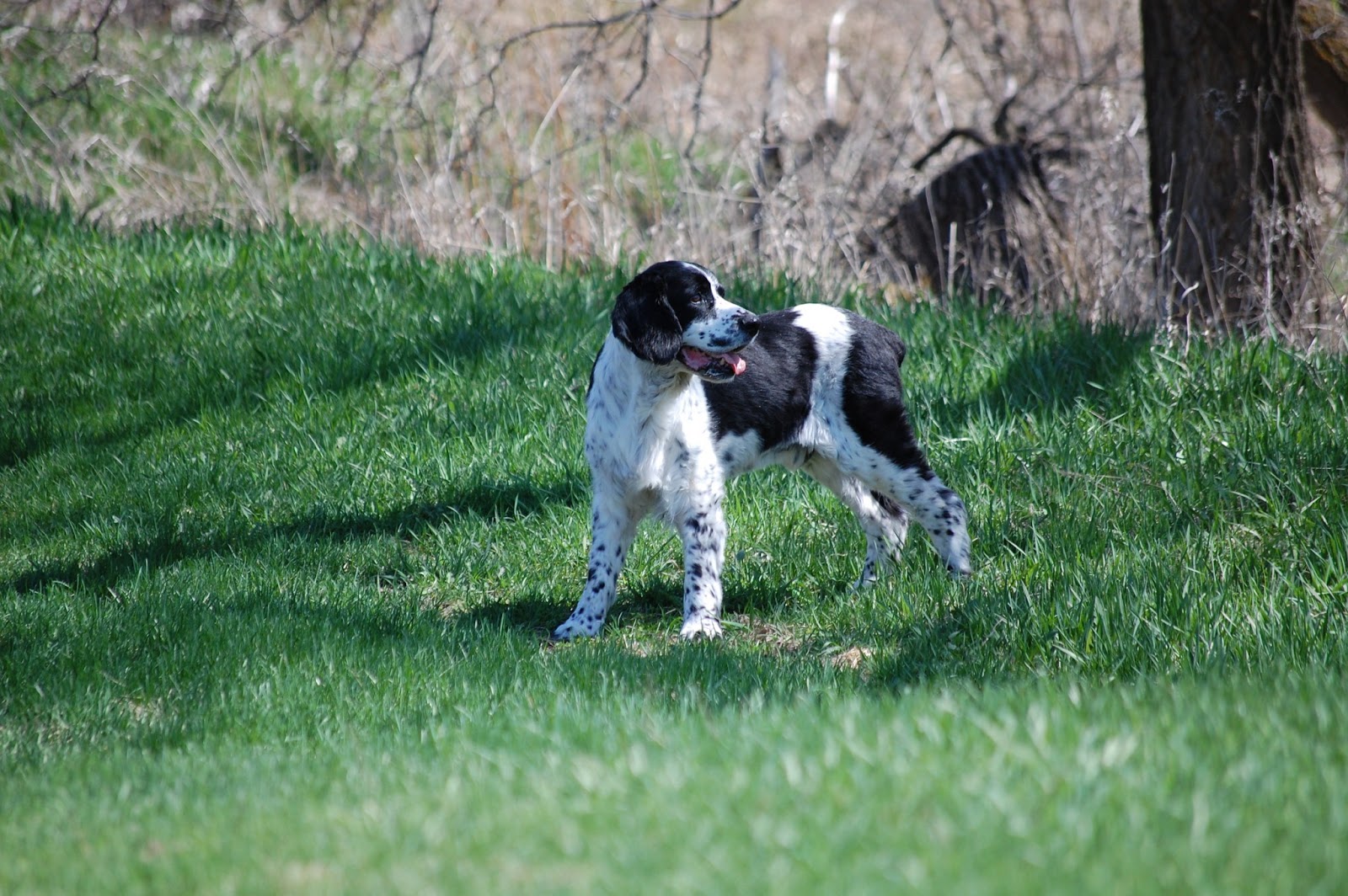
Good boy, Buzz. Good boy.
2013-03-20
Differences--Nature vs Nurture?
Bailey's here for the night. As I was driving to pick her up from the parking lot I was meeting my mom in today (like that doesn't sound sketchy) I started thinking about the fact that sometimes it's hard to imagine she and Buzz are the same breed. They look different, they interact with dogs differently, but most interesting to me is the fact that they interact with people in vastly different ways.
I've often said I'd love a stable Bailey. I've also often said I'd love a Buzz with a tail and without allergies. Truth be told, I covet a stable Bailey more. She's just a very different dog, in a very good way. She's going to guarantee a good laugh and make me feel like an awesome trainer every time I work with her.
As I tried to put a single word on what makes her so different from Buzz I thought about how she related to other dogs I've experienced. And I can't find one.
She has always enjoyed interactions with humans almost more than anything in the world. She naturally checks in on people when out and about. It's not something I had to teach, she just did it.
She inherently enjoys playing with people, and playing physical games with people. Sure, I've been too "rough" in play occasionally that'll put her off but she's always come back for more. She will initiate play with me and she'll solicit attention with the desire to DO something, not just be pet.
And I wonder if it comes down to nature, nurture, or both. Bailey was born and raised in the living room of her breeder's home. She was exposed to multiple people throughout the 8 weeks she lived with her breeder. Since the day I got her, she's been one of those "shadow without being in the way" dogs. She always wants to engage with the people in her life, indoors, outdoors, in a new environment... it's really who she is.
In contrast, Buzz was born in an outside kennel and lived with his parents/siblings for the first almost 9 weeks of his life. There's just not a whole lot of interaction he could have gotten, had his breeders made a point of getting out to interact with the puppies even daily. I didn't realize how much of an issue his indifference to people would be. It was honestly a huge struggle to learn how to work with him, to make him care about ANY resource that I could control. In the end we were able to compete in a variety of sports successfully but only because there was the promise of food at the end of each and every run. Something I had to work insanely hard to teach him. I had to micromanage every training session so that he was never given the opportunity to disengage and leave. Buzz got the worst of both situations. He wasn't exposed to humans enough to learn that they can be a valuable resource, and I didn't know enough when I got him to help "fix" that at 9 weeks old.
After being out with Bailey tonight, I realized just how much I crave what she is, in a stable package, in my next dog. I want a dog that inherently cares about people, a dog that enjoys playing games with people, (and a dog that was born enjoying retrieving... Buzz has a solid retrieve, for food).
I've often said I'd love a stable Bailey. I've also often said I'd love a Buzz with a tail and without allergies. Truth be told, I covet a stable Bailey more. She's just a very different dog, in a very good way. She's going to guarantee a good laugh and make me feel like an awesome trainer every time I work with her.
As I tried to put a single word on what makes her so different from Buzz I thought about how she related to other dogs I've experienced. And I can't find one.
She has always enjoyed interactions with humans almost more than anything in the world. She naturally checks in on people when out and about. It's not something I had to teach, she just did it.
She inherently enjoys playing with people, and playing physical games with people. Sure, I've been too "rough" in play occasionally that'll put her off but she's always come back for more. She will initiate play with me and she'll solicit attention with the desire to DO something, not just be pet.
And I wonder if it comes down to nature, nurture, or both. Bailey was born and raised in the living room of her breeder's home. She was exposed to multiple people throughout the 8 weeks she lived with her breeder. Since the day I got her, she's been one of those "shadow without being in the way" dogs. She always wants to engage with the people in her life, indoors, outdoors, in a new environment... it's really who she is.
In contrast, Buzz was born in an outside kennel and lived with his parents/siblings for the first almost 9 weeks of his life. There's just not a whole lot of interaction he could have gotten, had his breeders made a point of getting out to interact with the puppies even daily. I didn't realize how much of an issue his indifference to people would be. It was honestly a huge struggle to learn how to work with him, to make him care about ANY resource that I could control. In the end we were able to compete in a variety of sports successfully but only because there was the promise of food at the end of each and every run. Something I had to work insanely hard to teach him. I had to micromanage every training session so that he was never given the opportunity to disengage and leave. Buzz got the worst of both situations. He wasn't exposed to humans enough to learn that they can be a valuable resource, and I didn't know enough when I got him to help "fix" that at 9 weeks old.
After being out with Bailey tonight, I realized just how much I crave what she is, in a stable package, in my next dog. I want a dog that inherently cares about people, a dog that enjoys playing games with people, (and a dog that was born enjoying retrieving... Buzz has a solid retrieve, for food).
2012-12-03
Doing the right thing.
When people talk about doing the right thing, it's usually regarding something other than the relationship had with a dog. In the last week, I made a heart-wrenching decision based on a a culminating event. Bailey has struggled to live in the city with me. She is stressed daily, she's conflicted daily, and she's unhappy... daily.

Bailey has been taking vacations to visit my mom for weeks at a time since early summer. This was to help give her time to relax so that she could live with me in the city again. And for a while it worked really well! She'd go away for a week or two, I'd pick her up and life would be okay for a couple more weeks in the city. And then it stopped working. She started getting anxious when I'd leave my bedroom to take a shower, she'd be so scared of being out of my bedroom that she'd just glue herself to my leg, and then she was so over threshold that she was getting upset with Buzz almost daily. We tried a lot of management techniques with very little, to no, improvement. I tried giving her Clonidine more regularly but it wasn't even helping on the evenings I had to work.

Last Sunday,she was dropped off at my house after her most recent vacation with my mom.
The scenario went something like this:
Brother calls--he's here!
I go outside to get her and she's so happy and wiggly!
We get her stuff out of the car and head toward the house.
She steps inside the house. Her tail drops, her ears go back, and I stared in disbelief... I didn't know what to do.
She was terrified of being in this house. It has so many negative associations that I just can't undo, that she just can't overcome. I know she's a sensitive soul and she was trying so damn hard, just so I could have her with me.
 Last week I made the decision to let Bailey live with my mom indefinitely. I did not make this decision lightly, in fact I stressed about it for days. In the end, all of the friends I discussed it with agreed: she's so unhappy living here with me. It's such an unnecessary unhappiness as well. When she's at the farm with my mom, she's a completely different dog. She woo-woos in the morning because she's just so damn happy. She goes for multiple walks each day, in the middle of nowhere. She can relax in any area of the house she chooses because there are no other dogs.
I'll still see her, and I'm sure I'll visit more often now, but she won't have to come back to the city with me. My mom says she looks for me to come home from work every day for the first week or so, but then it gets better.

I'm not doing the right thing for me, because I tried that already, and it didn't work out. I'm doing the right thing for Bailey, because she deserves it.


Bailey has been taking vacations to visit my mom for weeks at a time since early summer. This was to help give her time to relax so that she could live with me in the city again. And for a while it worked really well! She'd go away for a week or two, I'd pick her up and life would be okay for a couple more weeks in the city. And then it stopped working. She started getting anxious when I'd leave my bedroom to take a shower, she'd be so scared of being out of my bedroom that she'd just glue herself to my leg, and then she was so over threshold that she was getting upset with Buzz almost daily. We tried a lot of management techniques with very little, to no, improvement. I tried giving her Clonidine more regularly but it wasn't even helping on the evenings I had to work.

Last Sunday,she was dropped off at my house after her most recent vacation with my mom.
The scenario went something like this:
Brother calls--he's here!
I go outside to get her and she's so happy and wiggly!
We get her stuff out of the car and head toward the house.
She steps inside the house. Her tail drops, her ears go back, and I stared in disbelief... I didn't know what to do.
She was terrified of being in this house. It has so many negative associations that I just can't undo, that she just can't overcome. I know she's a sensitive soul and she was trying so damn hard, just so I could have her with me.
 Last week I made the decision to let Bailey live with my mom indefinitely. I did not make this decision lightly, in fact I stressed about it for days. In the end, all of the friends I discussed it with agreed: she's so unhappy living here with me. It's such an unnecessary unhappiness as well. When she's at the farm with my mom, she's a completely different dog. She woo-woos in the morning because she's just so damn happy. She goes for multiple walks each day, in the middle of nowhere. She can relax in any area of the house she chooses because there are no other dogs.
I'll still see her, and I'm sure I'll visit more often now, but she won't have to come back to the city with me. My mom says she looks for me to come home from work every day for the first week or so, but then it gets better.


I still hope that I will be able to change my living, and work, situation to accommodate her better in the future. For now though, I won't feel guilty for putting her through so much every single day.
Subscribe to:
Posts (Atom)